
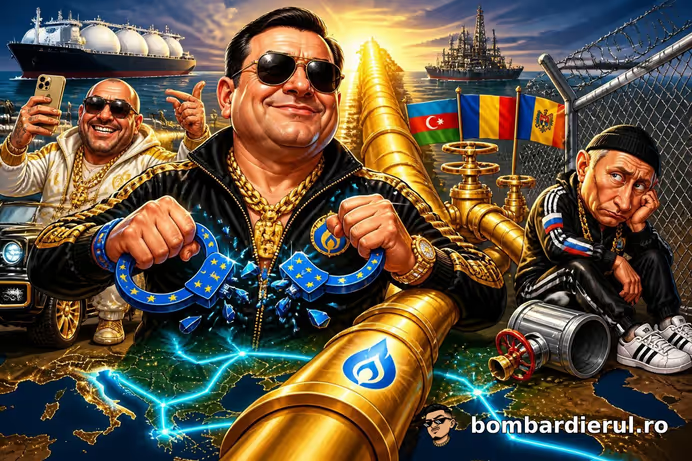
Bro, hold on tight and put that cold beer down for a sec, because I've got news that cuts through the air sharper than my BMW's exhaust after a night of flexing! The European Commission gave the green light, man! On June 5, 2026, right when I was watching the news with Mioara and my mother-in-law, Veta, who was cursing 'the Germans for stealing our gas' – boom, the news: Transgaz revised those commitments from six years ago, back in 2020, when they dodged a fine of up to 10% of their turnover. Now, instead of sitting on their hands and blocking exports, they can sell competitive export capacities at the border with Bulgaria and Ukraine. In our terms: we're unleashing the gas, bro, no more clogged sink!
Man, this story started way back in 2016, when Transgaz was inspected by the EU, and in 2017 they started nitpicking. They said Transgaz was delaying interconnections and blocking exports. So in 2020, to avoid the fine, Transgaz promised to ensure minimum export capacities: 1.75 billion cubic meters per year to Hungary (at Csanádpalota, man!) and 3.7 billion per year to Bulgaria (at Giurgiu/Ruse and Negru Vodă/Kardam). They also promised not to discriminate on tariffs and to invest in BRUA – that's the Bulgaria-Romania-Hungary-Austria pipeline. Nice, right? But in six and a half years, on the Romania-Bulgaria route, not a single cubic meter was booked! Zero, bro! Like our lottery – lots of promises, few results.
Now, in May 2026, Transgaz came to the Commission and said: 'Hey, let us change the rule, because this isn't working.' Ion Sterian, the head of Transgaz, explained that the conditional capacity was blocking the Vertical Corridor – that's a route bringing gas from the Caspian Sea, from LNG terminals in Greece (Revithoussa and Alexandroupolis) and from Azerbaijan, straight into Central and Eastern Europe, so we don't depend on Russian gas. And, bro, after six years of talks with DG Competition, the Commission said 'okay, go ahead'. So now Transgaz can auction competitive capacity packages, meaning they allocate based on demand, no more shackles. God, that sounds good!
But wait, it's not all milk and honey. Sterian also said tariffs have already been reduced (by 60% at Isaccea and 90% in Moldova), but recent auctions didn't attract traders because pipelines in Bulgaria are still under construction – the Rupcha-Vetrino line (63 km) and the Kardam station are delayed due to weather. So for now, capacity at Kardam is 5 billion cubic meters per year (14.5 million m³/day), but after completion, it will double to 9.5 billion (27 million m³/day). Translation: we wait some more, bro, as usual.
Now, check out what we, Romanians, gain. Besides no longer being Russia's lapdogs – because the EU decided to completely ban Russian gas from January 1, 2027 – Transgaz will make money from transit, pay taxes, fees, profit, and dividends to the state (which holds 58% through the General Secretariat of the Government). And, bro, our prestige in Europe grows! 'We're talking about the security of gas supply not only for Romania but also for Moldova, which is 100% dependent on the Trans-Balkan Corridor,' Sterian said. And he's right: Transgaz built BRUA (completed in November 2019), modernized stations at Siliștea, Onești, and Gherăiești, built the Onești-Gherăiești-Lețcani pipeline and the Lețcani-Iași-Chișinău link, bringing Moldova into the European network. That's how it's done, bro, not like others with 'long talk, short money'.
Let's say that until December 31, 2026, the modified commitments remain in force, and an independent administrator will monitor implementation. I say it's good news, but let's not get carried away. Because in the end, we still pay the bills, right? I'm going to explain to Mioara that maybe, just maybe, the gas price will drop this year – though, with how slick these guys are, I'd better not get my hopes up. Cheers!