
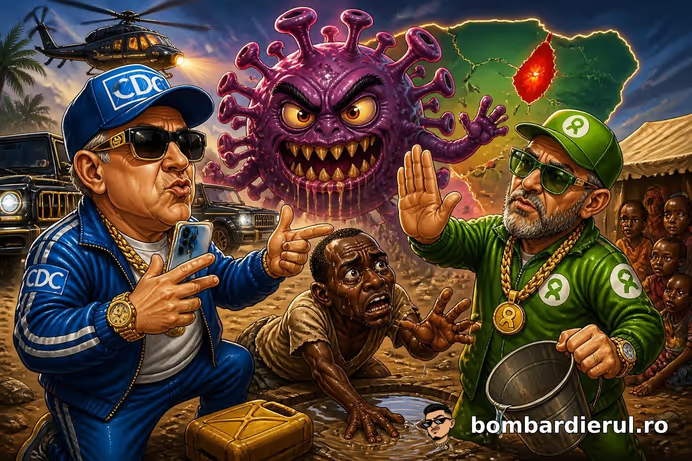
Man, I'm gonna put lead in your veins! I was chilling with my coffee and energy drink, scrolling through my phone, and I stumbled upon a news story that left me speechless. We're talking about Ebola, bro, not a cold! The US Centers for Disease Control and Prevention, that CDC with the fancy name, confirmed that the outbreak in the Democratic Republic of Congo is the largest ever recorded for the Bundibugyo strain. And get this: Oxfam, that organization that busts its ass all over the world, says the official numbers are way off from reality. Basically, it's total chaos, cuz!
Listen up here: the real number of cases is probably much higher than reported, because they don't have drinking water and hygiene conditions. Oxfam makes it clear: the hygiene infrastructure has collapsed, and contact tracing – the thing that should keep the virus under control – has dropped like a rock. In Ituri province, one of the epicenters, only one in five medical facilities has enough drinking water. In Mongbwalu, a city of nearly 140,000 people, only 20% have access to drinking water and 25% to sanitation services. I mean, bro, you drink tap water and you don't know if you're getting Ebola for free.
Manel Rebordosa, Oxfam's field coordinator in Ituri, said it straight: 'Water – absolutely the first line of defense in any public health emergency – is simply not available.' And he's not joking: the miners working there have no toilets, no handwashing stations, then they go back to their villages and spread the virus. Drinking water costs $2 for 20 liters – for the families there, that's like a salary, bro. Me, back in Berceni, when the pipe broke and I had no water for a day, I went crazy. But there, it's life and death, no joke.
And it's not just water. Contact tracing coverage has dropped to 43%, meaning less than half. In the 2018-2020 outbreak in the same region, they reached 79% – almost eight out of ten contacts were monitored. Now, after the US pulled its funding for disease surveillance, that's it, bro: the virus moves freely. Rebordosa said this gap isn't just a statistic, but a painful reality that allows the virus to spread undetected. And get this: over 70 medical facilities have been destroyed by conflict, and in the DRC there are only 0.2 doctors per 1,000 people. I mean, with how many doctors we have in our state hospitals, I can't even believe it can be worse, but it is, cuz.
In North Kivu province, people die at home and only afterward do they find out it was Ebola. Entire families care for sick relatives at home, and that's how it keeps spreading. Humanitarian funding for the DRC has been cut from $2.58 billion in 2024 to $1.4 billion in 2026 – a 46% drop. As a result, aid organizations have reduced their activities, and community outreach teams have disappeared. And then, bro, what do people do? They go to witch doctors, to traditional remedies, because they're afraid of hospitals – they see them as death traps. Rebordosa said: 'When trusted community outreach teams disappear, rumors spread faster than the virus.'
Tibakanya Mireille, a mother of five from Ituri, lived through it: one of her kids got a fever and she took him to the hospital. Now he's being tested. She said two houses were quarantined, and a family lost several members after caring for a sick relative. 'The disease has already killed several people in our community in Shari, in Bunia.' You get it, bro? A mother sits and prays it's not Ebola.
Oxfam tried to intervene: a budget of $11.6 million over six months for water and hygiene kits for 200,000 people in Ituri. But it's a drop in the ocean. Without an authorized vaccine for this strain, clean water and hygiene are the only weapons. And if nobody moves, the virus will knock on our door too, like Mioara said I shouldn't drink energy drinks from the vending machine because I'll kick the bucket. For now, I'm gonna go tell Brian to wash his hands 10 times a day, because that's what we pay water and sewage for. But in Africa, bro, it's a tragedy: they don't even have that much.